
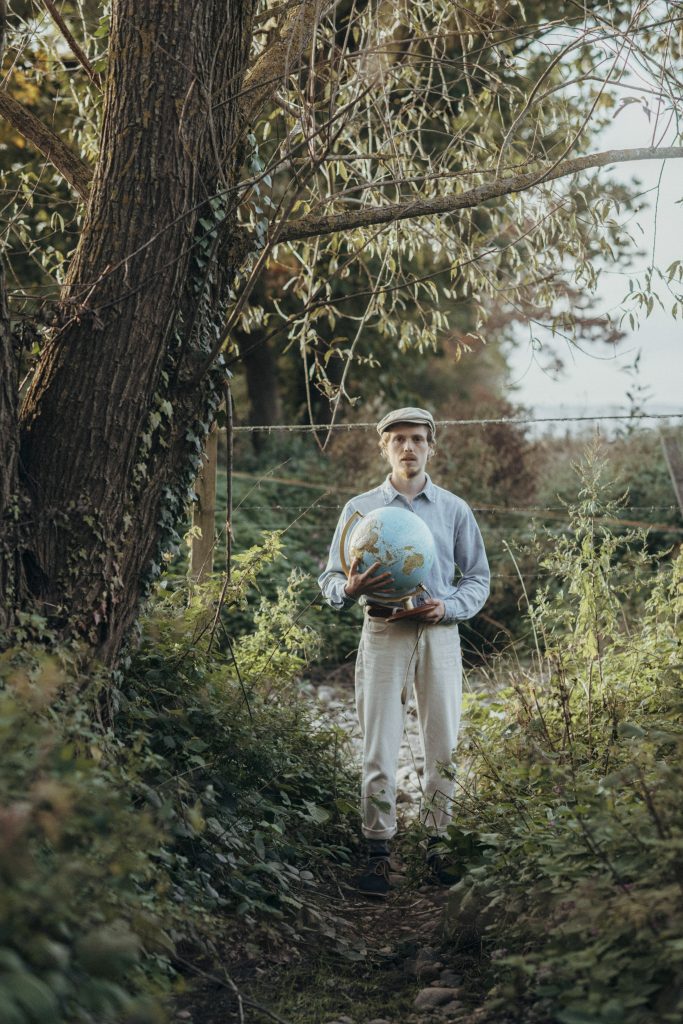
Hi! I’m Dominik, musician and culture-shifter.
If there’s one thing I take from 25 years as a composer, pianist, and singer, it’s this:
To make touching music means being touchable.
Many musical challenges — stage fright, the fear of the blank page — have, over the years, thrown me back onto my own emotional world. And when a song is really good, it’s because I want to dance for joy, have to cry, or get goosebumps. But being touchable also means staying aware of what’s happening in the world. In the end, music led me to engage with my own world-feelings.
My life’s journey
As a teenager, I discovered that I could best put my feelings into music. My love of storytelling drove me toward film scoring and songwriting from the start. I found my first musical home in a Bachelor’s in Composition at the University of Music and Performing Arts Graz, before turning definitively to film music and studying film composition at the Filmakademie Baden-Württemberg, taking my first steps as a singer-songwriter along the way — supported, among others, by Fola Dada and Alina Gause. The piano and my home studio became the space where I could feel, dream, and create everything.
But every dream I lived out also brought a change in me. What I’d initially accepted as an unavoidable way of feeling — a “film score” made of loneliness, powerlessness, and suppressed anger — caught up with me in my mid-twenties. I could no longer ignore my emotional baggage, and didn’t want to either. One thing led to another, and I soon found myself in the Rage Club, one of 20 participants, screaming my soul out.
That was the starting point for my engagement with Possibility Management as taught by Clinton Callahan. The experience of fully allowing and navigating my anger, my fear, my grief, and my joy changed my life. My relationships grew deeper, my steps bolder. On stage, too, I had entirely new flow experiences. And I completed the Rage Club Spaceholder Training with Eva Daubert and Oliver Arnold, so I could hold feeling spaces myself.
Meanwhile, a great deal had happened: Covid, the war in Ukraine, the global backlash of autocracies. The growing social division could no longer be overlooked. Part of the feelings and emotions I’d suppressed until then turned out to be tied to this collective development too. With a newfound drive to research, I went looking for people working with these world-related feelings, and came across deep ecologist Joanna Macy.
“We believe ourselves to be so fragile and small that allowing ourselves to look at our feelings about the state of the world would tear us to pieces. We fear a deep depression or paralysis. In fact, the opposite is true.”
Interview with Joanna Macy in „Ursache/Wirkung No. 128: Verbundenheit“
Inspired by Macy’s legacy — and informed by my experience with Possibility Management — I developed new formats to stay capable of action myself and to contribute to change. At the core of my work is the distinction between:
Feelings
- arise in the moment and refer to the situation at the moment
- last only a few minutes and fade away as soon as you have fully felt them and/or are acting upon them
- exist in four categories: rage, fear, sadness and joy
- are created by you for yourself
- contain energy and information you need in order to act
- can come in combinations of two or more, but they don’t mix. They have a clear direction
Emotions
- are unfinished feelings and refer to a past situation
- are stored in the body and are triggered again and again, until you have fully felt them
- exist in four categories: rage, fear, sadness and joy
- are created by you for yourself
- contain energy and information you need in order to heal
- can mix (e.g. into resignation, hatred, despair, exuberance, schadenfreude, nostalgia, guilt, contempt, jealousy, greed, paralysis…) and take your orientation away
This distinction is the key to clear, authentic action. Living it means to take radical responsibility for your thoughts, feelings and actions.
Do you feel that the world is your business too?
Then join the team at the world-feelings research space! Or subscribe to my newsletter and get inspiring texts, song releases, and event invitations from me, straight to your inbox.